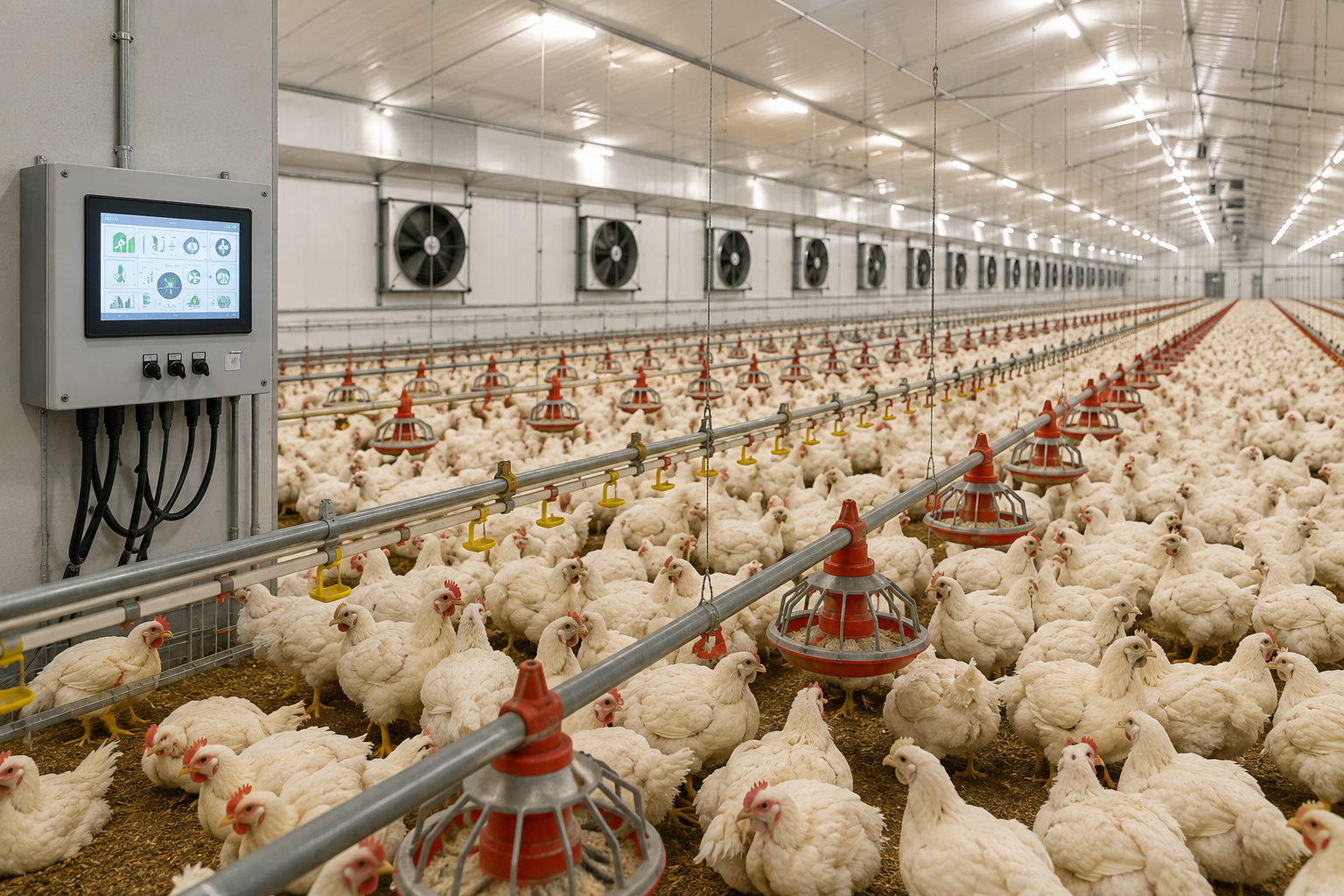
Smart Automation in Commercial Poultry Farming: How to Run a High-Capacity Farm with Minimal Labor
Labor availability and cost have become two of the most persistent operational challenges in commercial broiler production, particularly as farms scale toward higher capacity and rural labor markets in many production regions face ongoing tightness. Smart automation has emerged as the primary strategic response, allowing well-designed modern facilities to manage substantially larger flock volumes with a fraction of the labor input required by traditional manual operations.
This guide examines the automation systems that make minimal-labor, high-capacity broiler operations possible, the practical staffing models these systems enable, and the investment and risk considerations B2B investors should weigh when evaluating or developing an automation-forward facility.
Why Labor Efficiency Has Become a Strategic Priority
Traditional broiler farm operations historically required substantial daily manual labor for feeding, watering, environmental monitoring, and mortality removal — tasks that scale roughly linearly with flock size and house count under a manual model. This creates a structural challenge for investors seeking to scale operations, since labor costs and availability constraints can limit growth even when capital and market demand would otherwise support expansion.
Several converging factors have made automation-driven labor reduction a strategic priority rather than merely an efficiency nicety. Rural labor markets in many poultry-producing regions face persistent worker shortages, making it increasingly difficult to reliably staff multiple houses across a growing operation. Labor costs continue to rise in most markets, meaning that facilities dependent on large manual labor forces face a structurally higher and less predictable cost base than automated alternatives. Additionally, consistent, round-the-clock monitoring is difficult to achieve with human labor alone, since even attentive staff cannot continuously monitor every house simultaneously, creating gaps in environmental oversight that automation can close.
Core Automation Systems That Reduce Labor Requirements
A genuinely low-labor, high-capacity operation depends on several distinct automation systems working together, rather than any single piece of equipment. Understanding each component helps investors evaluate whether a facility’s automation is comprehensive or merely partial.
1. Automated feeding systems: Programmable feed delivery systems that automatically dispense measured feed quantities on a schedule, adjusting for bird age and growth phase, eliminate the substantial daily labor traditionally required for manual feeding across multiple houses.
2. Automated watering systems: Nipple drinker lines with automated pressure and flow regulation ensure consistent water availability without manual monitoring, while integrated leak detection can alert staff to equipment failures before they create wet litter or water shortage problems.
3. Climate control automation: Integrated systems that automatically adjust ventilation fan speed, curtain position, and heating based on real-time temperature and humidity sensor readings maintain optimal conditions without requiring constant manual adjustment throughout the day and night.
4. Lighting program automation: Automated lighting schedules that adjust intensity and duration according to programmed growth-phase requirements support both bird welfare and growth performance without daily manual intervention.
5. Environmental sensor networks: Continuous monitoring of temperature, humidity, ammonia, and carbon dioxide levels throughout each house provides the data foundation that climate control automation depends on, while also generating alerts when conditions move outside safe parameters.
6. Remote monitoring and mobile alert platforms: Centralized software platforms that aggregate data from all automated systems across multiple houses, presenting farm managers with a single dashboard view and immediate mobile alerts when any system requires attention, regardless of the manager’s physical location.
When these six systems are properly integrated, a facility can maintain optimal environmental and feeding conditions across multiple houses with a dramatically smaller on-site labor requirement than a comparable manually managed operation.
Staffing Models for Automated High-Capacity Operations
Automation does not eliminate the need for skilled labor entirely, but it fundamentally changes the nature and volume of labor required, shifting the staffing model from high-headcount manual task execution toward smaller teams focused on oversight, maintenance, and exception handling.
Typical Role Composition on an Automated Farm
A well-automated multi-house broiler operation typically requires a farm manager or technical supervisor responsible for overall flock health decisions, integrator liaison, and interpreting automation system data and alerts, alongside a smaller number of general labor staff handling tasks that remain difficult to fully automate, such as mortality removal, litter management between cycles, and physical equipment inspection. Larger operations may also justify a dedicated maintenance technician role, given that automated systems require more specialized upkeep than simple manual equipment, and equipment failures in a highly automated facility can have outsized consequences if not addressed promptly.
Comparing Labor Models by Farm Scale
The labor reduction becomes increasingly pronounced at larger scales, since automation systems and centralized monitoring platforms can oversee additional houses with only marginal increases in supervisory staff, whereas manual operations require labor scaling roughly in proportion to house count.
The Continued Importance of Skilled Oversight
It is worth emphasizing that minimal-labor does not mean minimal-skill. Automated facilities still depend heavily on knowledgeable farm managers capable of correctly interpreting sensor data, recognizing early signs of flock health issues that automation alone may not catch, and making sound judgment calls during genuine emergencies. Investors should be cautious of any operational model that treats automation as a substitute for competent management oversight rather than a tool that makes skilled management more effective and scalable.
Capital Investment and ROI Considerations
Transitioning to or building a highly automated facility requires meaningful upfront capital investment, and investors should model the return on that investment carefully rather than assuming labor savings alone justify any level of automation spending.
Typical Cost Drivers
Automation system costs vary considerably based on the sophistication of climate control integration, the extent of remote monitoring platform capability, and whether systems are being retrofitted into existing housing or designed into new construction from the outset. Retrofitting older housing with modern automation typically costs more per unit of capability than integrating automation into new construction, since existing structures often require additional wiring, sensor placement adaptation, and control system integration work.
Modeling the Labor Savings
Investors should model automation ROI based on realistic, farm-specific labor cost comparisons rather than generic industry figures, accounting for actual regional labor costs and availability, the specific staffing model the automated facility would require compared to a manual alternative, and the maintenance and technical support costs that automated systems introduce, which partially offset direct labor savings. A thorough model will also account for the value of improved consistency in environmental conditions and feeding, which can improve PEF and flock performance independent of the direct labor cost savings, providing a secondary return stream beyond staffing reduction alone.
Risk Considerations Specific to Automation
Automation introduces its own risk profile that investors should weigh alongside its benefits. Heavy reliance on automated systems increases the consequences of equipment or software failure, making the backup power and redundancy considerations discussed elsewhere in poultry facility risk management even more critical for highly automated operations. Additionally, staff at automated facilities need different skills than traditional manual labor — comfort with digital monitoring platforms and basic technical troubleshooting — which can require different hiring and training approaches than a traditional manual operation.
Building an Automation Strategy: A Phased Approach
Rather than attempting a full-scale automation retrofit or build-out in a single phase, many successful operators approach automation adoption incrementally, allowing each phase to be evaluated and refined before the next investment is made.
1. Start with climate control and feeding automation: These systems typically offer the most immediate, measurable labor savings and performance improvements, making them a logical starting point for both new construction and retrofit projects.
2. Add environmental sensor networks and alerting: Building on the core automation foundation, sensor networks and alert systems extend the early-warning and oversight capability of the facility without requiring a complete restructuring of existing systems.
3. Integrate remote monitoring across the full facility: Once individual house-level automation is established, integrating monitoring into a centralized platform allows management oversight to scale efficiently across multiple houses or farm sites.
4. Evaluate centralized, multi-farm monitoring for portfolio operations: Investors managing multiple farm sites can extend remote monitoring platforms across an entire portfolio, allowing a small central technical team to oversee environmental and equipment status across geographically dispersed facilities.
This phased approach allows investors to validate the labor savings and performance improvements at each stage before committing further capital, reducing the risk of over-investing in automation capability that does not deliver proportional returns for the specific farm’s scale and market conditions.
The Strategic Case for Automation-Forward Investment
For investors evaluating new broiler farm developments or considering upgrades to existing portfolio assets, automation capability has become an increasingly important factor in overall facility valuation and competitiveness, not merely an operational efficiency consideration. Facilities capable of reliably running at high capacity with minimal labor input are better positioned to scale, more resilient to regional labor market tightness, and often demonstrate more consistent flock performance due to the precision automation brings to environmental and feeding management — all factors that support stronger long-term operating economics and, ultimately, stronger asset value.
Investors evaluating acquisition targets or new development opportunities should treat the sophistication and integration quality of existing or planned automation systems as a core underwriting variable, alongside more traditional factors such as location, integrator relationships, and infrastructure condition.