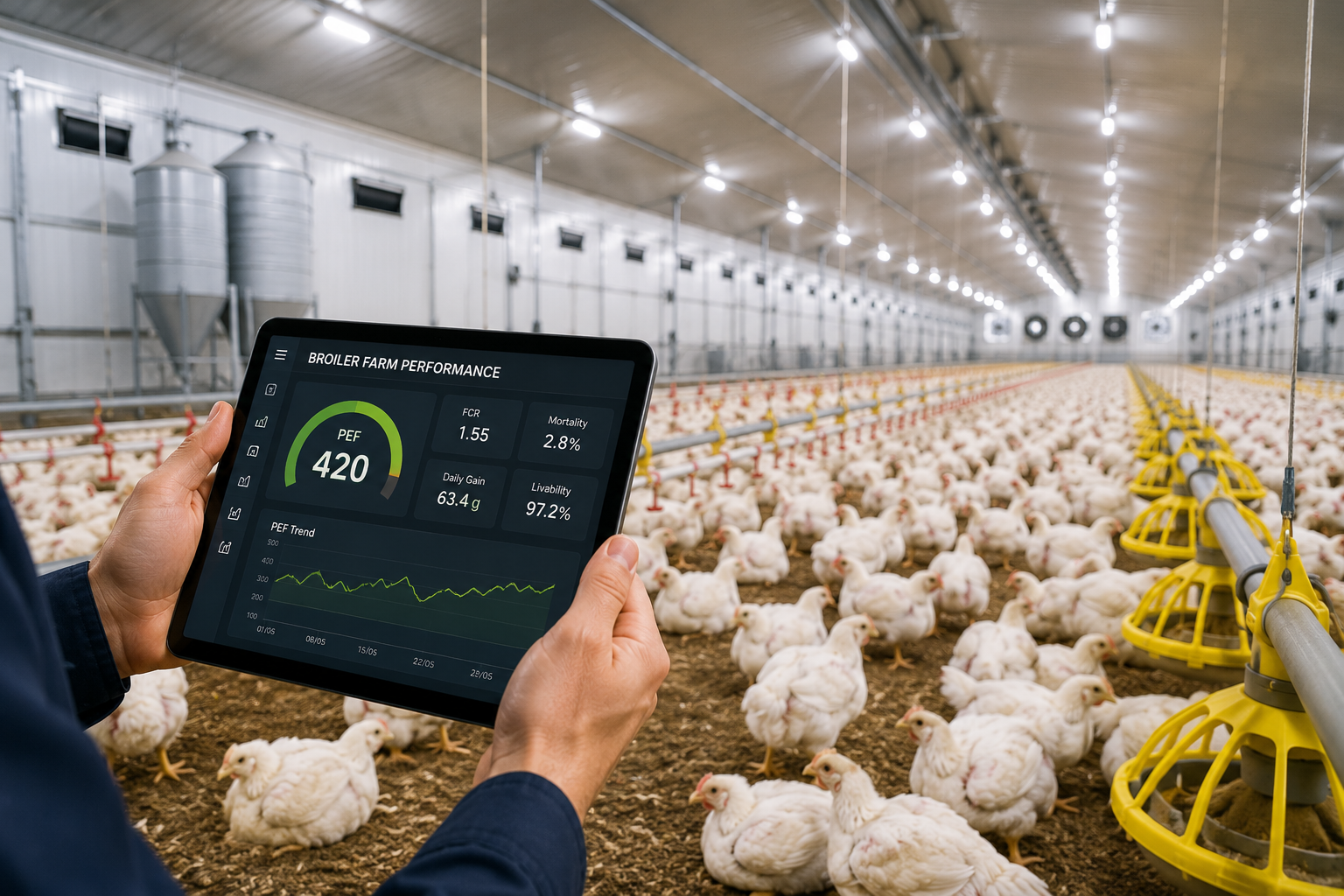
For integrators, contract growers, and institutional investors evaluating broiler operations, few metrics matter as much as the Production Efficiency Factor (PEF), also referred to internationally as the European Production Efficiency Factor (EPEF) or European Broiler Index (EBI). This single number condenses flock performance into a figure that directly drives grower payouts, benchmarking decisions, and investment underwriting across the poultry value chain.
This guide explains what PEF actually measures, why it has become the industry’s preferred performance benchmark, and five concrete, operationally grounded strategies producers can use to raise their score — and by extension, their payout per flock cycle.
What the Production Efficiency Factor Actually Measures
PEF is a composite index that combines four core flock performance variables into a single score, allowing producers, integrators, and buyers to compare flock performance across cycles, farms, and even countries using one standardized number. The formula is expressed as:
PEF = (Livability % × Average Live Weight in kg) ÷ (Age in Days × Feed Conversion Ratio) × 100
Each of the four inputs reflects a distinct dimension of flock management:
1. Livability: The percentage of birds that survive from placement to processing, reflecting biosecurity, health management, and environmental control quality.
2. Average live weight: The mean body weight of birds at the point of catching, reflecting genetics, nutrition, and growth management.
3. Age in days: The number of days from placement to catching, reflecting how efficiently the flock reached market weight.
4. Feed conversion ratio (FCR): The amount of feed consumed per kilogram of live weight gained, reflecting nutritional efficiency and feed management discipline.
Because PEF rewards higher livability and weight while penalizing longer cycle times and poorer feed conversion, it functions as a genuine efficiency benchmark rather than a simple output measure — a flock that grows heavy birds slowly with poor feed conversion will score lower than a flock that reaches a similar weight faster and more efficiently.
Why PEF Directly Drives Integrator Payouts
In contract growing arrangements, which dominate commercial broiler production in most markets, integrators typically supply chicks, feed, and veterinary support while contract growers provide housing, labor, and day-to-day management. Under this model, grower compensation is frequently structured around a base payment per kilogram of live weight delivered, adjusted upward or downward based on how the flock’s PEF compares to other flocks processed in the same settlement period.
This tournament-style payment system, common across major poultry-producing markets, means that a grower’s income is determined not by absolute performance alone, but by relative performance against peer flocks. A grower who improves PEF even marginally, while peer flocks remain flat, can see a meaningful payout increase — which is precisely why understanding and actively managing the components of PEF has become a core competency for successful contract growers.
How PEF Comparisons Typically Affect Payment

Exact thresholds and bonus structures vary by integrator and region, but the underlying logic is consistent: PEF is the currency in which flock performance is translated into grower income.
Five Ways to Maximize PEF and Improve Payouts
Improving PEF requires coordinated attention across all four of its underlying components, since a strong score in one area can be undermined by weakness in another. The following five strategies represent the areas where experienced growers and technical advisors consistently find the most impactful, achievable gains.
1. Tighten Livability Through Proactive Health Management
Livability is often the single largest lever available to growers because mortality events — even small ones — compound across the flock’s cycle. Practical steps include maintaining strict biosecurity protocols at every house entry point, monitoring early mortality patterns daily to catch disease or environmental issues before they escalate, and ensuring brooding temperature and humidity are tightly controlled during the first seven days, when chicks are most vulnerable. Even a one- or two-percentage-point improvement in livability can produce a noticeable PEF gain, since it directly multiplies against average live weight in the formula.
2. Optimize Feed Conversion Through Precision Nutrition and Feeder Management
Feed conversion ratio sits in the denominator of the PEF formula, meaning that even small improvements here produce outsized effects on the final score. Growers should work closely with integrator nutritionists to ensure feed formulations match the flock’s genetic strain and growth phase, minimize feed wastage through proper feeder height adjustment as birds grow, and monitor water quality and availability, since poor water intake directly suppresses feed efficiency. Feed represents the largest single cost in broiler production, so gains in FCR improve both PEF and raw profitability simultaneously.
3. Manage Environmental Conditions to Support Consistent Growth
Environmental stress — whether from heat, poor ventilation, or inconsistent lighting programs — slows growth rates and increases variability within the flock, both of which drag down average live weight and extend days to market weight. Growers should invest in tunnel ventilation systems calibrated to local climate conditions, maintain consistent lighting programs that support both growth and bird welfare, and monitor litter quality, since damp or caked litter increases foot pad lesions and stress that indirectly suppress growth performance.
4. Reduce Age to Target Weight Through Genetics and Early Growth Management
Age in days is the other denominator variable in the PEF formula, meaning that reaching target market weight faster — without sacrificing livability or feed efficiency — directly improves the score. This is achieved primarily through selecting genetic strains suited to the target market weight and local conditions, ensuring optimal early growth through proper brooding management in the first two weeks, and coordinating closely with integrators on placement scheduling to avoid unnecessary cycle extensions. Growers should be cautious here: pushing for faster growth at the expense of livability or feed efficiency can backfire, since PEF rewards balanced performance across all four variables, not speed alone.
5. Use Data Tracking to Identify and Replicate High-Performing Cycles
Growers who consistently rank in the top PEF tiers typically share one behavioral trait: rigorous, cycle-over-cycle data tracking that allows them to identify what specifically drove strong performance and replicate it. This includes maintaining detailed records of mortality patterns, feed consumption, and weight gain by house and by week, comparing performance across houses on the same farm to isolate management versus structural factors, and reviewing each cycle’s results with integrator technical staff to identify specific, actionable adjustments for the next placement. Over time, this data discipline compounds into consistently higher PEF scores, since small, targeted improvements accumulate across successive cycles.
Common Mistakes That Suppress PEF Scores
Even experienced growers can inadvertently suppress their PEF through avoidable missteps. The most common issues include delaying action on early mortality signals in the hope that conditions will self-correct, over- or under-feeding relative to genetic strain requirements due to generic rather than strain-specific feeding programs, inconsistent environmental control caused by reactive rather than proactive equipment maintenance, and inadequate biosecurity between flock cycles that allows pathogen carryover to affect the following flock’s livability. Addressing these systematically, rather than treating each cycle in isolation, is what separates consistently top-tier growers from those with volatile, unpredictable performance.
Why PEF Matters Beyond Individual Flock Payouts
For institutional investors and integrators evaluating contract grower networks or acquisition targets, aggregate PEF performance across a farm’s flock history is one of the clearest available indicators of management quality and operational discipline. A farm with consistently strong PEF scores across multiple cycles signals robust biosecurity, disciplined nutrition management, and effective environmental control — all factors that reduce operational risk and support more reliable production forecasting for buyers and investors alike.