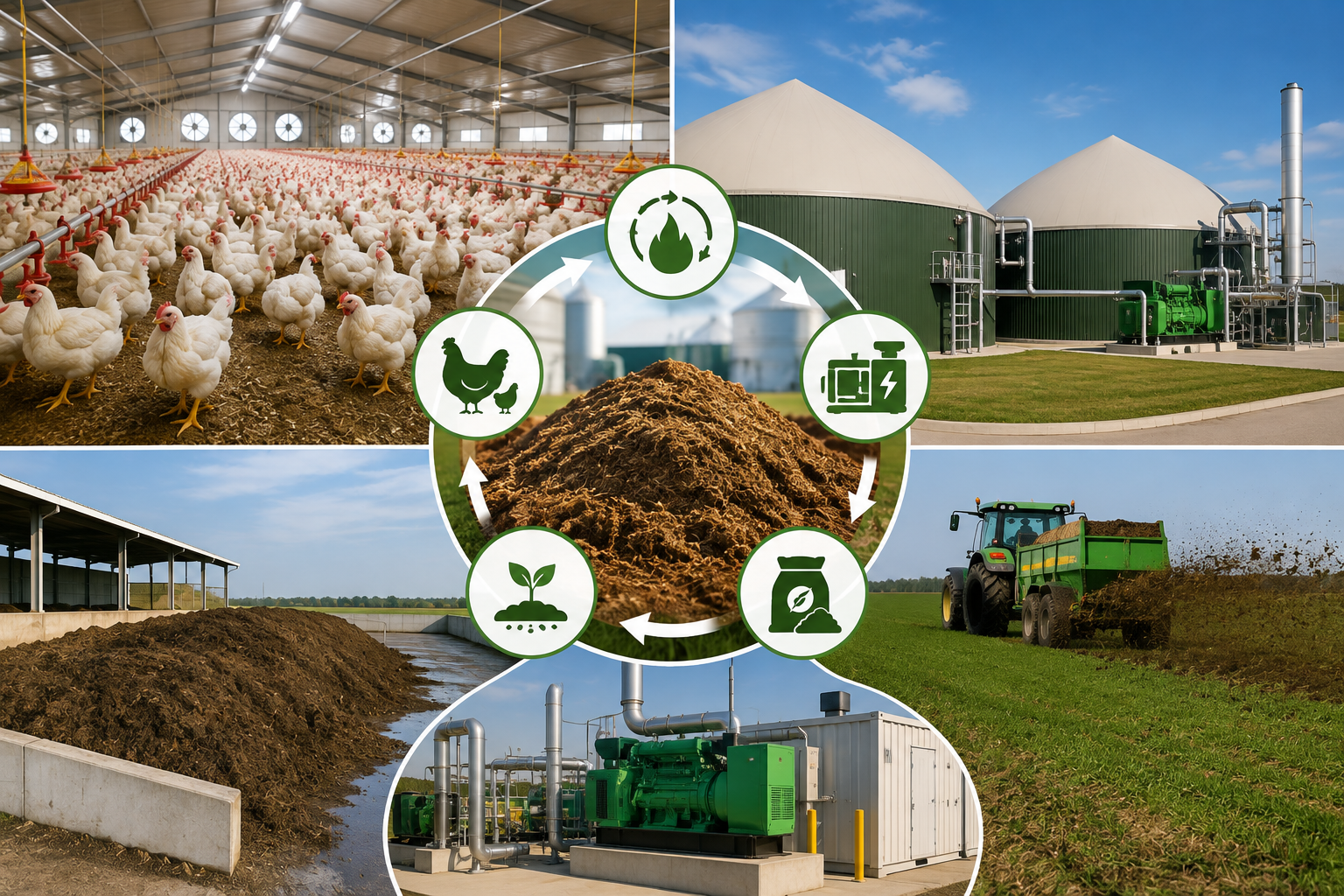
For decades, poultry manure was treated primarily as a waste management liability — a byproduct requiring disposal rather than an asset generating revenue. That framing has shifted substantially as biogas technology, organic fertilizer markets, and carbon credit mechanisms have matured to the point where well-structured manure management can transform from a cost center into a meaningful secondary revenue stream for broiler operations.
This guide examines the primary monetization pathways available to poultry producers, the infrastructure and investment required to capture them, and the practical economics investors should model before committing capital to manure-to-revenue conversion projects.
Why Poultry Manure Has Become a Valuable Feedstock
Poultry manure carries several characteristics that make it particularly attractive as a feedstock for both biogas production and organic fertilizer markets compared to manure from other livestock sectors. It has a relatively high nitrogen content compared to cattle or swine manure, making it valuable as a nutrient-dense fertilizer input. It also has favorable carbon-to-nitrogen ratios for anaerobic digestion when properly blended with other feedstocks, and broiler operations generate manure in concentrated volumes at predictable, high-density collection points, which substantially reduces the logistics cost of aggregating feedstock compared to more dispersed livestock operations.
These characteristics mean that a single broiler operation of meaningful scale can generate manure volumes sufficient to support standalone monetization infrastructure, rather than requiring aggregation across multiple unrelated farms — a significant practical advantage for individual farm investors evaluating these opportunities.
The Three Primary Monetization Pathways
Poultry manure can be converted into revenue through several distinct channels, each with different infrastructure requirements, capital intensity, and revenue characteristics.
1. Biogas and electricity generation: Manure is processed through anaerobic digestion to produce biogas, which can be combusted on-site to generate electricity for farm use or sale to the grid, or upgraded to biomethane for injection into gas networks or use as vehicle fuel.
2. Organic and pelletized fertilizer production: Manure is processed, dried, and often pelletized into a stable, transportable organic fertilizer product sold to crop farmers, landscaping operations, or specialty agricultural markets willing to pay a premium for organic-certified nutrient sources.
3. Carbon credit generation: Properly documented manure management systems that demonstrably reduce methane emissions compared to conventional storage and disposal practices can qualify for carbon credit generation under various voluntary or compliance carbon market frameworks, creating a revenue stream independent of the physical biogas or fertilizer product itself.
Many sophisticated operations pursue a combination of these pathways simultaneously, since anaerobic digestion produces both biogas and a nutrient-rich digestate byproduct that can itself be processed into fertilizer, effectively capturing revenue from the same feedstock through two channels.
Biogas Production: Infrastructure and Economics
Anaerobic digestion systems convert manure into biogas through a controlled microbial breakdown process, and the scale and sophistication of the required infrastructure varies considerably depending on farm size and intended end use of the gas produced.
Core Infrastructure Components
A functional biogas system typically requires a manure collection and pre-treatment system to remove contaminants and standardize feedstock consistency, an anaerobic digester tank or lagoon system sized to farm manure volume and desired retention time, a gas capture and storage system to manage biogas before combustion or upgrading, and either a combined heat and power (CHP) generator for on-site electricity use or a gas upgrading system if biomethane injection or vehicle fuel use is the intended application.
Revenue Models for Biogas Output
The economics of biogas monetization depend heavily on which output pathway a farm pursues. On-site electricity generation offsets the farm’s own power costs and can generate additional revenue through excess electricity sales to the grid where feed-in tariff or power purchase agreement structures exist. Biomethane upgrading for grid injection typically commands a higher per-unit value than raw electricity generation but requires substantially more capital-intensive upgrading equipment, making it more economically viable at larger production scales. Vehicle fuel applications remain a smaller but growing market, particularly in regions actively incentivizing renewable natural gas adoption in transport fleets.
Capital and Scale Considerations
Biogas infrastructure carries meaningful upfront capital requirements, and the economics generally favor larger operations or aggregated multi-farm projects where fixed infrastructure costs can be spread across greater feedstock volumes. Smaller individual farms should carefully model whether standalone biogas infrastructure achieves acceptable payback periods, or whether participation in a regional aggregated digestion facility — contributing manure as feedstock in exchange for a revenue share — presents a more favorable risk-adjusted return.
Organic Fertilizer: A Lower-Capital Entry Point
For producers seeking manure monetization without the capital intensity of biogas infrastructure, organic fertilizer production represents a comparatively accessible entry point, though it carries its own processing and market development requirements.
Processing Requirements
Converting raw manure into a marketable fertilizer product typically involves composting or controlled drying to reduce moisture content and stabilize the material, pathogen reduction processes to meet food safety and agricultural input regulations, and often pelletizing to improve product handling, storage, and transport economics compared to bulk raw or composted material.
Market Positioning and Pricing
Organic fertilizer derived from poultry manure competes in a market segment that includes both conventional organic soil amendments and premium, certified-organic inputs demanded by specialty and export-oriented crop producers. Pricing varies considerably based on nutrient content consistency, certification status, and regional demand from organic and sustainable agriculture markets, with certified organic-input buyers typically willing to pay meaningfully more than conventional bulk fertilizer markets.
Distribution Considerations
Unlike biogas, which typically requires proximity to grid infrastructure or on-site consumption, fertilizer products can be transported to more distant markets, opening distribution options beyond the immediate farm region. However, this also means fertilizer monetization requires more active market development and customer relationship management than biogas, which often sells into more standardized grid or utility offtake arrangements.
Carbon Credits: An Emerging but Complex Revenue Layer
Carbon credit generation from improved manure management has grown as a monetization pathway, but it requires more specialized technical and regulatory expertise than the physical product pathways described above.
How Manure-Based Carbon Credits Typically Work
Carbon credit methodologies applicable to poultry operations generally quantify the methane emissions avoided by processing manure through controlled anaerobic digestion or improved storage practices, compared to a baseline scenario of conventional open storage or disposal. These avoided emissions are converted into tradeable carbon credit units, which can be sold into voluntary carbon markets or, in some jurisdictions, compliance markets tied to specific regulatory frameworks.
Requirements and Considerations
Generating verifiable, sellable carbon credits typically requires third-party verification against a recognized carbon methodology standard, ongoing monitoring and reporting infrastructure to document emissions reductions over time, and engagement with carbon project developers or aggregators who can navigate the registration and verification process on behalf of individual farm operations. Given this complexity, many producers pursue carbon credit revenue through partnership with a carbon project developer rather than attempting to navigate registration and verification independently, trading a share of credit revenue for reduced administrative burden and technical risk.
Comparing the Three Pathways

Investors evaluating these pathways should recognize that they are not mutually exclusive — a well-structured facility can pursue biogas generation, process the resulting digestate into fertilizer, and layer carbon credit revenue on top of the same underlying infrastructure investment, meaningfully improving overall project economics compared to pursuing any single pathway in isolation.
Building a Realistic Investment Case
Before committing capital to manure monetization infrastructure, investors should model several key variables with realistic, conservative assumptions rather than best-case projections. These include actual manure volume and nutrient consistency based on flock size and management practices rather than industry averages, realistic offtake pricing and contract terms for whichever pathway is pursued, full infrastructure and ongoing operating costs including maintenance, labor, and monitoring requirements, and a realistic timeline for regulatory approval, grid interconnection, or carbon credit registration, since these processes frequently take longer than initial project planning assumes.
Producers who already operate at meaningful scale, with consistent flock cycles and established farm infrastructure, are generally best positioned to evaluate manure monetization as a genuine secondary revenue stream rather than a marginal add-on, since the fixed costs of processing infrastructure are more easily absorbed across larger, more consistent feedstock volumes.
The Strategic Case for Manure Monetization
Beyond the direct revenue potential, well-structured manure management infrastructure can also strengthen a farm’s overall investment profile by reducing environmental compliance risk, improving relationships with local communities and regulators concerned about waste management practices, and providing a hedge against future regulatory tightening around agricultural waste disposal. For investors evaluating broiler farm acquisitions or new developments, the presence — or planned addition — of manure monetization infrastructure is increasingly a relevant factor in overall asset valuation, not simply an operational afterthought.