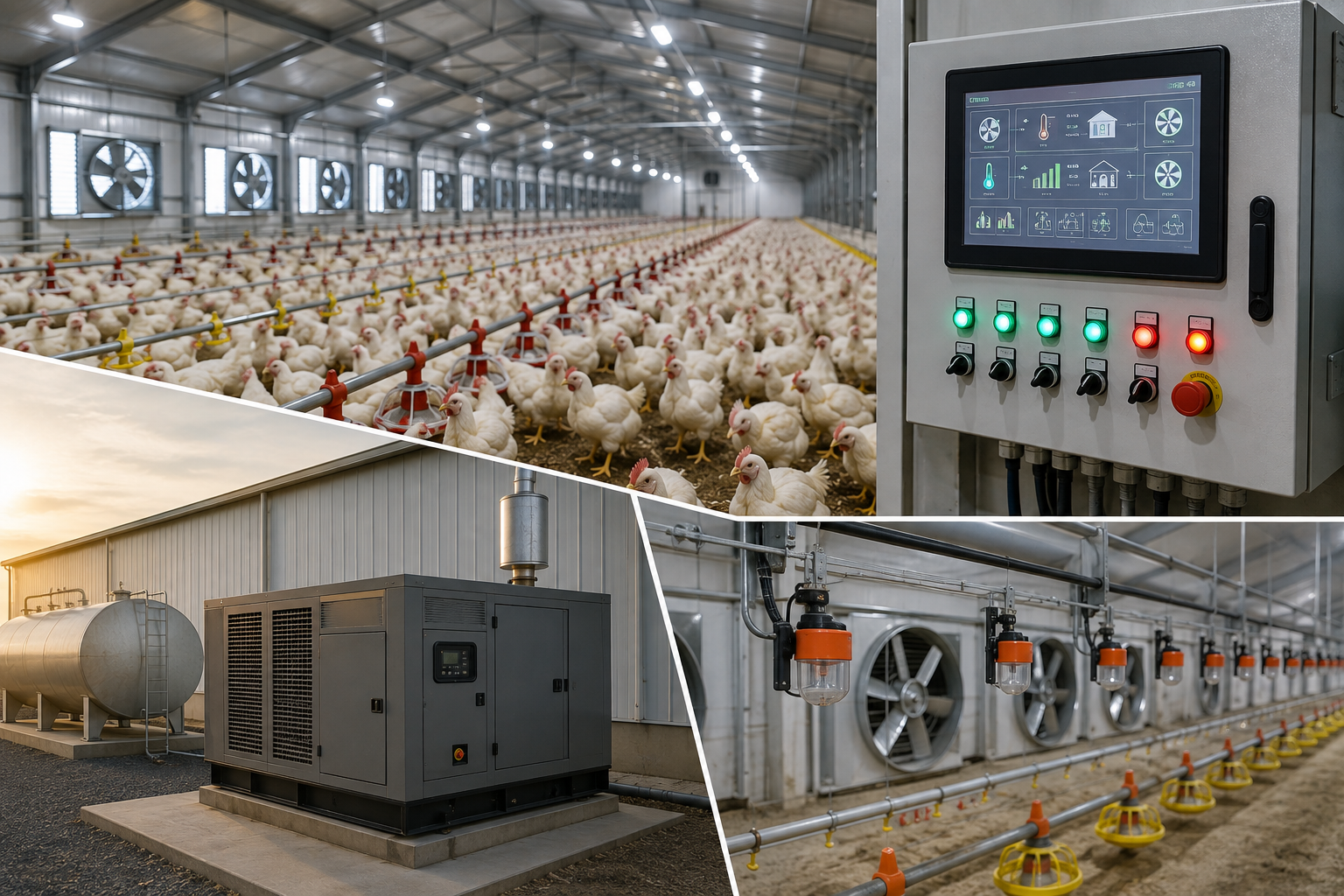
Few risks in commercial broiler production are as financially devastating, or as preventable, as a mass mortality event caused by power or ventilation failure. A single extended power outage during peak summer heat can wipe out an entire flock in a matter of hours, converting weeks of feed, labor, and management investment into a total loss. For investors and integrators evaluating broiler operations, the presence — or absence — of robust backup power and automation infrastructure is one of the clearest indicators of operational risk management maturity on a farm.
This guide examines why power and ventilation failure represents such an acute risk in modern broiler housing, the backup power and automation technologies used to mitigate it, and how investors should evaluate this infrastructure when underwriting a farm acquisition or new development.
Why Modern Broiler Housing Is So Vulnerable to Power Failure
Modern high-density broiler houses are fundamentally dependent on continuous mechanical ventilation to remain viable environments for the birds inside them. Unlike older, naturally ventilated housing designs, contemporary tunnel-ventilated houses pack significantly more birds per square meter, which means the metabolic heat generated by the flock itself becomes a serious threat within minutes of ventilation failure, particularly during hot weather or in the final weeks of a grow-out cycle when birds are at their heaviest and most heat-sensitive.
Several factors compound this vulnerability. Fully enclosed, environmentally controlled houses have little to no passive airflow to fall back on if fans stop, meaning internal temperatures can climb to lethal levels far faster than in open-sided housing. Birds in the final stage of the grow-out cycle carry the most body mass and generate the most metabolic heat, making late-cycle flocks the most vulnerable to any ventilation interruption. Additionally, high stocking densities — a standard feature of modern efficient production — mean that even a short ventilation gap affects a very large number of birds simultaneously, amplifying the financial impact of any single failure event.
The Financial Stakes of a Mass Mortality Event
The economic consequences of a mass mortality event extend well beyond the immediate loss of the birds themselves, and understanding the full scope of financial exposure is essential for justifying investment in preventive infrastructure.
1. Direct flock loss: The immediate cost of lost birds, calculated against the feed, chick, veterinary, and labor investment already made in that flock cycle at the time of the event.
2. Lost revenue from the cycle: Beyond the sunk cost of inputs, the farm also loses the expected revenue from that flock’s sale, representing a complete cycle of lost income rather than merely lost cost.
3. Facility downtime and cleanup: A mass mortality event typically requires extended house downtime for carcass disposal, deep cleaning, and disinfection before the next flock can be safely placed, extending the revenue gap well beyond the loss event itself.
4. Integrator relationship damage: Under most contract growing arrangements, a mass mortality event affects a grower’s PEF-based performance ranking and can damage the trust relationship with the integrator, potentially affecting future placement allocation or contract terms.
5. Insurance and financing implications: Repeated mortality events can affect a farm’s insurability and the terms available on future financing, as lenders and insurers increasingly factor operational risk management infrastructure into their underwriting.
Given this layered financial exposure, the cost of a comprehensive backup power and automation system is typically recovered many times over by preventing even a single major mortality event across a facility’s operating life.
Core Components of a Robust Backup Power System
A properly engineered backup power system for broiler housing involves considerably more than simply owning a generator, and investors should evaluate the full system architecture rather than assuming generator ownership alone constitutes adequate protection.
Automatic Transfer Switches and Detection Speed
The critical variable in backup power performance is not generator capacity alone but detection and transfer speed — the time between a grid power failure and the backup system fully restoring ventilation function. Automatic transfer switches that detect outages and initiate generator start-up without requiring manual intervention are essential, since delays waiting for staff to notice and respond to an outage can be fatal to a flock, particularly during overnight hours when farms are unstaffed.
Generator Capacity and Redundancy
Backup generators must be sized to handle full farm ventilation, lighting, and feeding system loads simultaneously, not merely a reduced emergency subset, since partial ventilation capacity may be insufficient to prevent heat stress in a fully stocked house during extreme weather. Larger, multi-house operations should also evaluate whether a single centralized generator with distribution infrastructure, or multiple smaller house-level generators, better matches their redundancy and reliability requirements, since a single point of failure in a centralized system can expose the entire farm simultaneously.
Fuel Supply and Runtime Planning
Backup generators require adequate on-site fuel storage to sustain operation through extended outages, and farms should model realistic worst-case outage durations — including scenarios involving broader regional grid failures or severe weather events that may also disrupt fuel resupply logistics — rather than sizing fuel storage only for brief, routine outages.
Regular Testing and Maintenance Protocols
A backup generator that fails to start during an actual emergency provides no protection at all, regardless of its rated capacity. Rigorous, scheduled testing under load — not merely a brief no-load start-up check — is essential to verify that the system will perform as intended during a genuine outage, and testing records should be maintained as part of the farm’s overall risk management documentation.
Automation Systems That Extend Beyond Backup Power
Backup power addresses the catastrophic failure scenario, but modern automation systems increasingly provide an additional layer of protection by detecting and alerting on developing problems before they escalate into full failures.
Environmental Monitoring and Alert Systems
Automated sensor systems continuously tracking temperature, humidity, ammonia levels, and airflow within each house can detect developing environmental problems well before conditions become life-threatening, triggering alerts to farm management or remote monitoring services even outside normal working hours. This early-warning capability is particularly valuable for catching gradual equipment degradation — such as a partially failing fan or a clogged air inlet — that might not trigger a complete power failure alert but can still create dangerous conditions if left unaddressed.
Remote Monitoring and Mobile Alerts
Modern farm automation platforms increasingly allow farm managers to monitor critical environmental parameters remotely via mobile applications, and to receive immediate alerts when conditions move outside safe operating ranges. This capability significantly reduces response time compared to systems that rely solely on staff physically present at the farm noticing a developing problem, which is particularly valuable for smaller operations that may not maintain continuous overnight staffing.
Integration Between Power Backup and Automation Layers
The most robust farm risk management setups integrate backup power systems and environmental automation into a single coordinated system, so that a power failure simultaneously triggers both the automatic generator transfer and an alert notification to farm management, providing both the physical response (restored ventilation) and the human oversight layer (confirmation that the system responded correctly) simultaneously.
Comparing Risk Mitigation Tiers
Not all farms invest in the same level of backup power and automation sophistication, and the appropriate tier depends on farm scale, climate risk, and the investor’s overall risk tolerance.
For institutional investors evaluating an acquisition, the protection tier currently in place is a meaningful data point in overall risk assessment, and upgrading from a lower tier to a more comprehensive system is often one of the more cost-effective risk-adjusted improvements available post-acquisition.
Due Diligence Questions for Investors Evaluating Farm Risk Infrastructure
When evaluating a broiler farm acquisition or assessing an existing portfolio asset, several specific questions help establish whether backup power and automation infrastructure genuinely provides the protection its presence might suggest.
1. Is the transfer from grid to backup power automatic, or does it require manual intervention? Manual-start systems introduce dangerous response-time risk, particularly during unstaffed overnight hours.
2. Is the generator sized for full-load operation, or only a reduced emergency subset of farm systems? A generator that cannot support full ventilation capacity may fail to prevent heat stress during extreme conditions.
3. How frequently is the backup system tested under actual load, and are testing records maintained? Untested systems carry meaningful risk of failing precisely when needed.
4. Does the farm have environmental monitoring capable of detecting developing problems before a full failure occurs? Early-warning systems meaningfully reduce the risk of a minor equipment issue escalating into a mass mortality event.
5. What is the farm’s documented mortality event history, and were any prior incidents linked to power or ventilation failures? Historical incident patterns often reveal whether existing infrastructure has been genuinely adequate under real-world conditions.
The Investment Case for Comprehensive Risk Infrastructure
While backup power and automation systems represent a meaningful upfront and ongoing maintenance cost, the asymmetry between this investment and the potential cost of even a single mass mortality event makes comprehensive risk infrastructure one of the more clearly justified capital allocations available to broiler farm operators. Beyond the direct financial protection, farms with demonstrated, well-documented risk infrastructure are typically viewed more favorably by integrators during contract negotiations, by lenders during financing underwriting, and by prospective buyers during acquisition due diligence — making this an investment that supports value across multiple dimensions of the operation simultaneously.
For investors currently evaluating broiler farm acquisitions, or assessing risk exposure across an existing portfolio, a systematic review of backup power and automation infrastructure should be a standard component of operational due diligence, not an afterthought addressed only after a costly incident has already occurred.