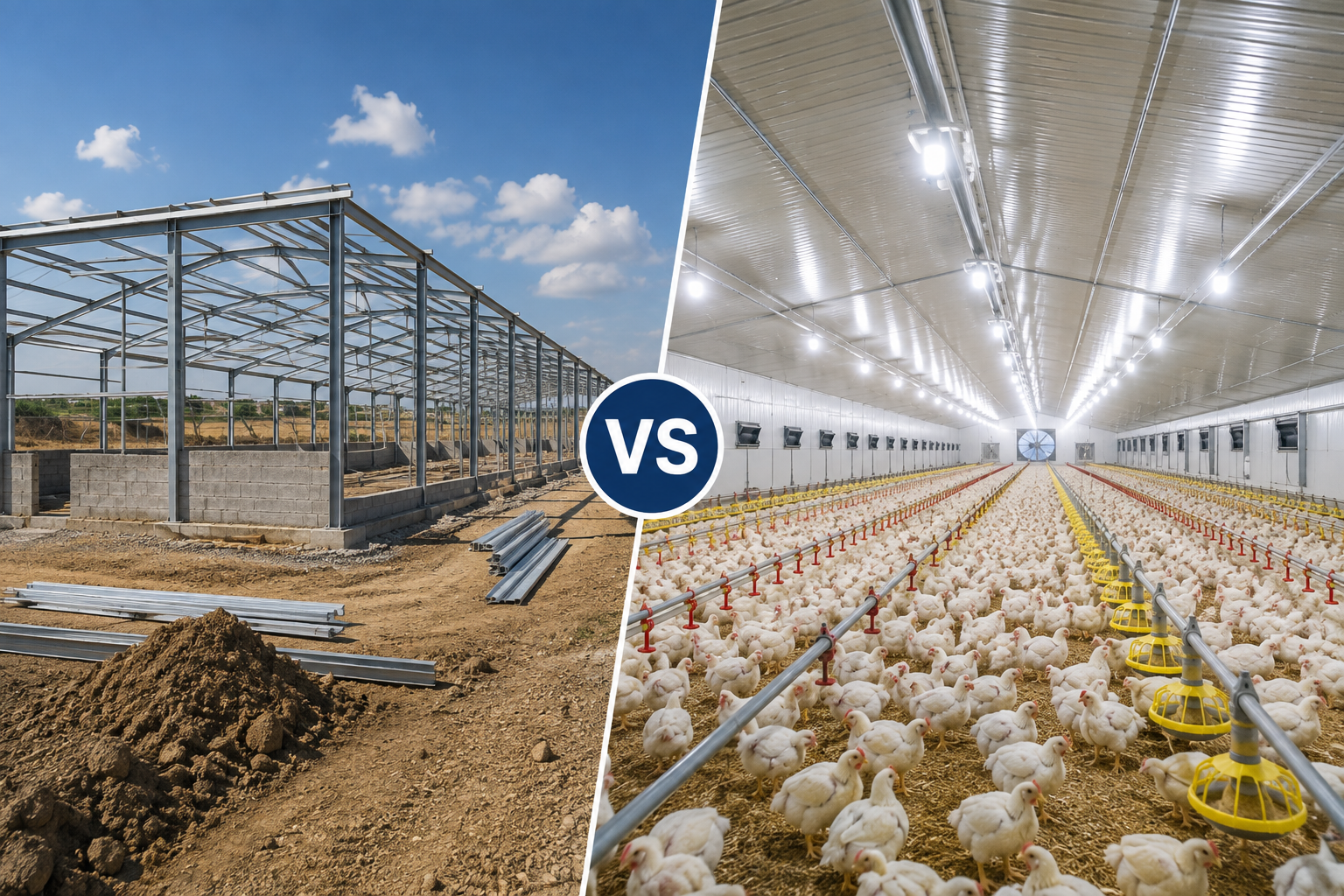
Building a Poultry Farm from Scratch vs. Buying a Turnkey Operating Facility
Institutional investors and strategic buyers entering the poultry production sector face one of the most consequential decisions early in the process: whether to build a greenfield facility from the ground up, or acquire an existing turnkey operation that is already licensed, staffed, and producing. Both paths can deliver strong returns, but they carry fundamentally different risk profiles, capital deployment schedules, and time-to-revenue horizons.
This guide breaks down the operational, financial, and regulatory considerations that should inform this decision, with a focus on the kind of due diligence B2B investors and acquisition teams typically require before committing capital to either route.
Framing the Decision: What “Build” and “Buy” Actually Mean in Poultry Production
Before comparing costs and timelines, it is worth clarifying what each path involves in practical terms, since the poultry sector has some structural characteristics that differ from other agricultural or industrial investments.
Building from scratch (greenfield development) typically involves:
1. Securing land with appropriate zoning and environmental clearance for livestock production.
2. Designing and constructing broiler houses, feed storage, water treatment, and biosecurity infrastructure.
3. Procuring equipment (ventilation, feeding systems, climate control) and commissioning it to operational standards.
4. Recruiting and training farm management and technical staff from the ground up.
5. Establishing supply relationships for day-old chicks, feed, and veterinary services.
Buying a turnkey facility typically involves:
1. Acquiring an operating farm with existing licenses, permits, and regulatory approvals already in place.
2. Inheriting an established workforce, management systems, and standard operating procedures.
3. Taking over existing supplier and, in many cases, buyer contracts.
4. Assuming the facility’s existing production track record, including flock health history and yield data.
The two paths are not simply different price points on the same product — they represent fundamentally different risk-to-control trade-offs.
Capital Requirements and Cost Structure Comparison
Cost is usually the first variable investors examine, but a straight price comparison can be misleading unless it accounts for what each option includes. Greenfield construction requires larger upfront capital outlay spread over a longer period, while turnkey acquisition concentrates cost into a single transaction but often at a premium reflecting the value of an operating, revenue-generating asset.

For investors prioritizing speed to cash flow, the turnkey route generally wins. For those prioritizing long-term cost efficiency and facility customization, greenfield construction often produces a lower total cost per production unit once amortized over the asset’s operating life.
Timeline Realities: How Long Each Path Actually Takes
One of the most underestimated variables in greenfield poultry development is the cumulative effect of regulatory and construction lead times. Environmental permitting alone can take several months, and biosecurity-compliant construction standards for modern broiler houses require specialized contractors, which can extend build schedules beyond initial projections.
Typical Greenfield Timeline Milestones
1. Site selection and zoning approval: Often the single largest source of delay, particularly where local livestock density regulations restrict new farm permits.
2. Design and engineering: Climate control, ventilation, and biosecurity systems require specialized engineering sign-off before construction begins.
3. Construction and equipment installation: Physical build-out of broiler houses and supporting infrastructure.
4. Commissioning and flock introduction: Initial flock cycles are often used to validate systems before scaling to full capacity.
By contrast, a turnkey acquisition can move from signed agreement to operational control within weeks, assuming due diligence uncovers no material licensing or compliance gaps that require remediation before closing.
Risk Considerations Unique to Each Approach
Every acquisition or development strategy carries risk, but the nature of that risk differs meaningfully between building and buying.
Risks in Greenfield Development
1. Permitting risk: Zoning changes, environmental objections, or shifting regulatory requirements can delay or derail projects after capital has already been committed.
2. Construction cost overruns: Material and labor cost inflation can erode projected returns if contracts are not structured with fixed-price protections.
3. Ramp-up risk: New facilities typically underperform design capacity during initial flock cycles as management systems and staff performance mature.
Risks in Turnkey Acquisition
1. Hidden liability exposure: Existing facilities may carry undisclosed biosecurity incidents, environmental compliance gaps, or equipment maintenance backlogs.
2. Contract transferability: Supplier and buyer contracts may include change-of-control clauses that complicate seamless transfer of commercial relationships.
3. Overpayment risk: Valuations based on optimistic historical performance can overstate the facility’s sustainable production capacity going forward.
A rigorous due diligence process — ideally including independent veterinary and engineering audits — is essential regardless of which path an investor chooses, but it is particularly critical in turnkey transactions where the seller controls the narrative around historical performance.
Return on Investment: Comparing Long-Term Economics
Return profiles differ not just in magnitude but in shape. Greenfield projects generally follow a J-curve, with capital outflows concentrated early and returns accumulating only after the facility reaches stable production. Turnkey acquisitions generate revenue from day one but require the purchase premium to be recovered before net returns materialize.
Key variables that shift the ROI comparison include:
1. Facility age and remaining useful life: Older turnkey facilities may require capex reinvestment sooner, narrowing the apparent cost advantage over greenfield construction.
2. Feed conversion efficiency: Modern greenfield designs often incorporate more efficient climate control and feeding systems, producing better feed conversion ratios than older acquired facilities.
3. Market entry timing: In markets with rising demand, the faster revenue generation from a turnkey acquisition can be strategically more valuable than marginal cost savings from building new.
4. Financing structure: Greenfield projects often qualify for agricultural development financing or government incentives not available to acquisition transactions.
Investors should model both scenarios using consistent discount rates and realistic ramp-up assumptions rather than comparing headline capex figures alone.
Which Path Fits Which Investor Profile
Neither approach is universally superior — the right choice depends on investor priorities, timeline constraints, and risk tolerance.
Building from scratch tends to suit investors who have longer investment horizons, want full control over facility specifications and biosecurity design, have access to development financing or government incentives, and are entering markets where suitable existing facilities are scarce or outdated.
Buying a turnkey facility tends to suit investors who need faster time to revenue, prefer to inherit established supplier and buyer relationships, want to avoid permitting and zoning risk entirely, and have the due diligence resources to properly vet an existing operation before closing.
Many sophisticated investors ultimately pursue a hybrid strategy: acquiring an initial turnkey facility to establish market presence and cash flow, while using the operational insight gained to inform a subsequent greenfield expansion built to their own specifications.
Final Considerations Before Committing Capital
Whichever path an investor chooses, the decision should be grounded in a detailed feasibility study that models realistic timelines, financing costs, and production ramp-up curves rather than best-case assumptions. Engaging experienced poultry sector advisors — with direct knowledge of local licensing environments and facility valuation benchmarks — materially reduces the risk of costly missteps in either direction.