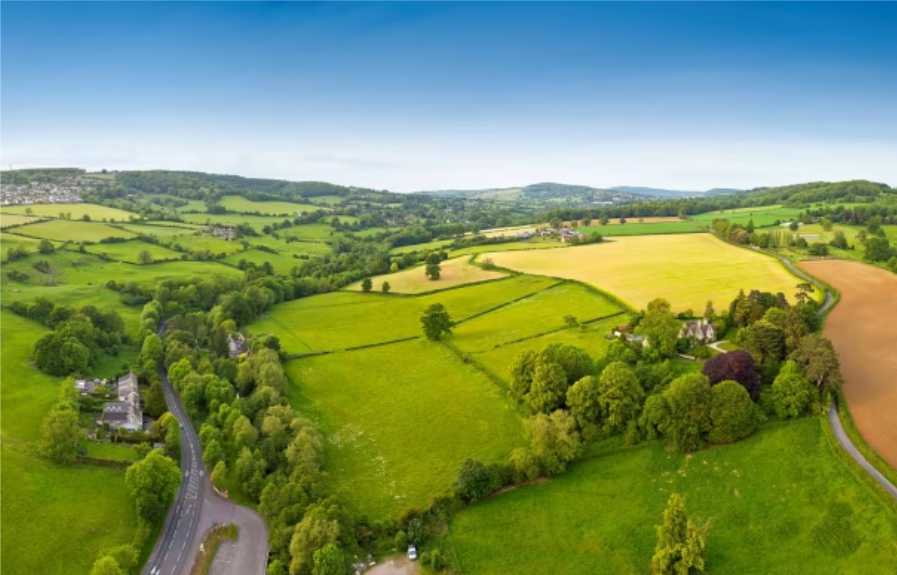
Over the past two decades, the UK farmland market has quietly transformed from a niche sector for rural families into one of the most resilient and attractive investment classes in Europe. Land has become more than soil — it’s now a store of value, a hedge against inflation, and increasingly, a climate asset.
For years, British farmland values have
outperformed many traditional investments. Even through global crises, prices
have remained remarkably stable. According to industry data, average farmland
values in England have nearly doubled since 2010, driven by both domestic and
international investors seeking security and sustainability.
But the next decade promises a different kind of
growth — one shaped not by subsidies or scarcity, but by climate adaptation and
innovation.
A Shifting Landscape
Southern England is getting warmer. Average
summer temperatures are rising, frost risk is declining, and rainfall patterns
are changing. The same climate models that once predicted wine-growing
potential in Kent and Sussex now show viability for olives, figs, and almonds
across parts of Surrey, Devon, and even Cornwall.
For investors, this means one thing: diversification.
Land that was once limited to grazing or cereal crops can soon host
higher-value Mediterranean products. Early adaptation is key — the investors
who move before mainstream adoption capture both capital appreciation and
operational yields.
Why Farmland Holds Long-Term Value
- Scarcity – The UK
has a fixed amount of agricultural land, and development pressures are
constantly reducing it.
- Resilience –
Farmland has historically weathered inflation, currency shifts, and market
turbulence better than most asset classes.
- Sustainability
Incentives – Government programmes like the Sustainable
Farming Incentive (SFI) now reward carbon reduction, biodiversity, and
regenerative farming. These programmes add secondary income layers to land
ownership.
- Global
Food Demand – Population growth and food security
concerns are keeping agricultural commodities in long-term demand, even as
production areas shift due to climate stress.
New Avenues for Agricultural Investment
Traditional farmland ownership is no longer the
only route. Many investors are exploring structured models — fractional
ownership, green investment funds, or agricultural partnerships that combine
profitability with environmental benefit.
InvestAgrolidya is among the companies studying this evolution closely,
connecting climate-resilient projects with long-term investors.
In the coming decade, the UK’s farmland market
may split into two categories:
- Legacy
farmland, where returns are stable but modest; and
- Climate
opportunity farmland, where innovation drives value through new
crops, renewable energy integration, or agro-tourism models.
Rising Interest in Southern Counties
Counties like Surrey, Kent, Sussex, Devon, and
Cornwall are fast becoming focal points for agricultural repositioning.
Land agents have reported increased inquiries from investors interested not
only in traditional farms but also small estates with potential for
sustainable, diversified production.
Looking Ahead
The decade ahead will likely redefine the
relationship between land and capital. Investing in farmland will no longer be
about owning acres — it will be about owning adaptability.
In that sense, the olive trees now appearing in
Surrey gardens are not just botanical curiosities — they’re a glimpse of the
agricultural future. The smart investor will recognise that the next
agricultural frontier may not be in southern Europe, but right here, in a
warming corner of England.