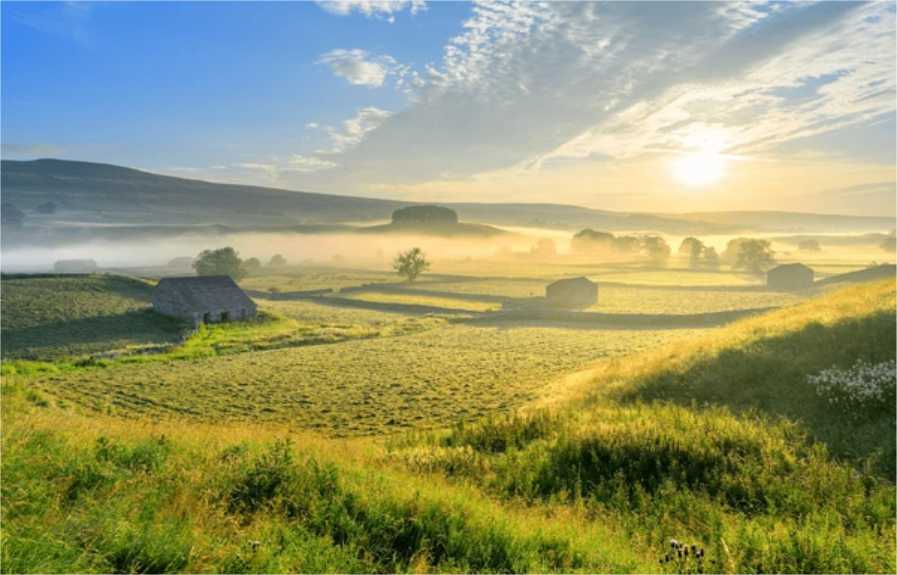
For generations, British farmland has been defined by its green pastures, grazing animals, and dependable rain. The idea of England as a cool, wet island suited for grass and cereal crops has shaped the entire rural economy. But that image is starting to fade.
In recent years, climate change has begun to quietly
redraw the agricultural map of the UK — and with it, the value system of land
itself.
A New Type of Farmland Value
Traditionally, farmland prices in Britain were
tied to productivity and location: rich soils in East Anglia, dairy-friendly
conditions in the South West, or scenic estates in the Cotswolds. Now, another
variable has entered the equation — climate potential.
As temperatures rise and the growing season
lengthens, southern England is becoming more compatible with crops that were
once limited to the Mediterranean basin. Meanwhile, regions that relied on
predictable rainfall are experiencing more extremes — longer droughts, heavier
downpours, and shifting seasons.
This change doesn’t just alter what farmers grow;
it transforms how investors think. Land that can adapt — through irrigation,
crop diversity, and regenerative practices — will appreciate in value faster
than land that can’t.
The Shift from Grazing to Growth
Grass-fed livestock and cereal farms may remain
part of the British landscape, but the focus is broadening. Farmers are
experimenting with drought-tolerant crops such as olives, grapes, nuts, and lavender.
These crops not only fetch higher market prices but also connect to growing
consumer demand for sustainable, local, and artisanal products.
A small parcel of land that once generated modest
returns from grazing could, in the right conditions, host a boutique olive
grove, vineyard, or agro-tourism site — blending agriculture with lifestyle and
hospitality.
For investors, this represents a clear evolution:
from passive landholding to active value creation.
Policy and Incentives Support the Transition
The UK government’s environmental land management
schemes, including the Sustainable Farming Incentive (SFI) and Countryside
Stewardship, reward farmers for practices that protect biodiversity, reduce
emissions, and improve soil health. These programmes are effectively turning
sustainability into a revenue stream.
In parallel, the demand for carbon credits
and biodiversity offsetting is rising. Landowners who adopt rewilding or
carbon-sequestering crops can generate income not just from production but from
the carbon market itself — a development unthinkable a decade ago.
Investors Are Taking Notice
Private funds and family offices are increasingly
looking at farmland as both an ethical and strategic investment. The
combination of tangible assets, long-term appreciation, and climate relevance
makes farmland one of the few sectors that aligns capital growth with
environmental impact.
Platforms like InvestAgrolidya are
watching these trends closely, exploring models where agriculture,
sustainability, and innovation intersect.
What the Future Holds
As climate change continues, farmland values will
no longer be dictated by geography alone but by adaptability —
irrigation access, crop resilience, and renewable integration. Properties that
can evolve will command a premium; those that can’t will stagnate.
In
short, British farmland is moving from tradition to transformation.
What was once “just pasture” may soon become the foundation of a new rural
economy — one defined not by the colour of its grass, but by the imagination of
those who invest in it.